
I still remember the first time I laid the foundation for Lakeview Manor back in 2012. I was standing on a windswept hill in Falkreath Hold, my pockets overflowing with iron ingots and sawn logs, and I felt a genuine thrill as the walls started going up. Hearthfire gave us something special—a quiet little corner of Skyrim to call our own, a place where we could hang our enchanted swords and display the dragon skulls we’d been hauling around for no good reason. It was homely, a bit janky, and absolutely charming. 🏡
Fast forward to 2026. The goodwill left by that modest homesteading has long since been trampled by an army of workbenches, supply lines, and radiant quests. Fallout 4’s settlement system was, in theory, an evolution of Hearthfire’s promise. In practice? It turned half the Commonwealth into a never-ending home renovation project that Preston Garvey just wouldn’t shut up about. Starfield then took that blueprint and stretched it across a thousand barren moons, leaving me staring at an outpost interface while whispering, “Can’t I just go back to chasing mudcrabs?”
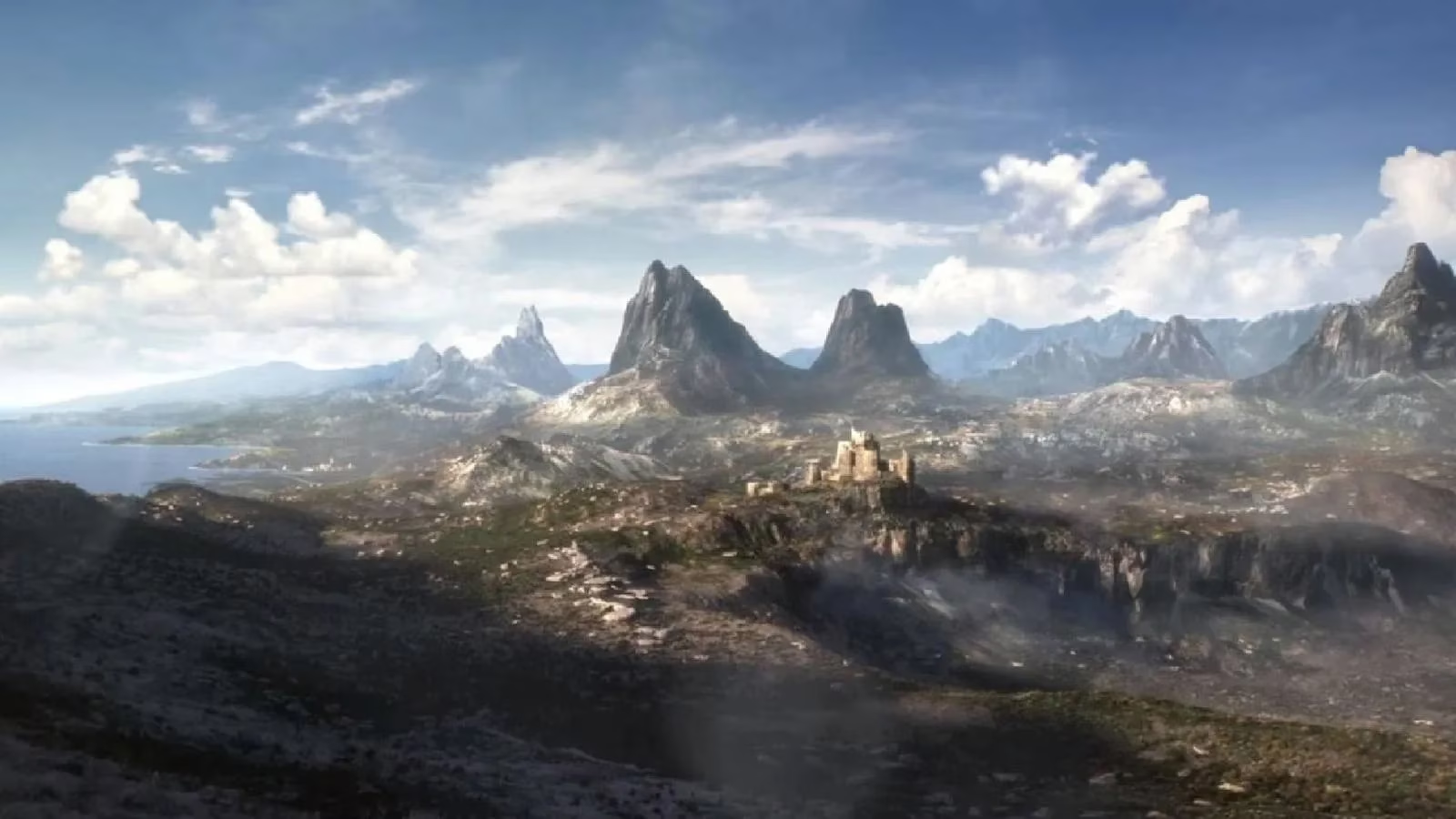
Now all eyes are on The Elder Scrolls 6, a game that still feels like a mirage shimmering on the horizon. And the question that pops up in every tavern, forum, and Discord server is: should settlement building make a comeback? If so, how? I’ve been poking around the community chatter, and let me tell ya—fans are more divided than a bandit camp after an argument over the last sweetroll.
What the community is saying
Some voices are practically shouting into the void. One weary adventurer wrote, “What I'm specifically hoping we don't get is a mechanic that requires building up entire communities using mass amounts of resources. I'm really hoping Bethesda utterly avoids anything remotely similar to FO4/Starfield's systems and we just get normal (preferably already decorated) houses in cities that act as player homes and nice little sinks for money.” I feel that in my bones. There’s a cozy magic in stepping into a pre-furnished manor in Cheydinhal or a penthouse in Solitude—no need to spend three hours aligning books on a shelf.
Others double down on the Hearthfire nostalgia, but with a firmer boundary. “By jove I hope not,” another fan grumbled. “It's a tedious mechanic that is just way more trouble than its worth. I'd much rather have the manors from Oblivion back where you can invest money into a specific home, but don't have to spend hours gathering random garbage.” Honestly, I can’t argue with that. There’s a huge difference between, “I just bought a smithy upgrade for my stronghold” and “I need seventeen desk fans to build a turret.” One feels like living in a world; the other feels like an unpaid internship. 😅
But it’s not all anti-building sentiment. A fair number of fans genuinely loved the creative freedom. They talk about building their own little Roriksteads—small, bespoke villages nestled in the countryside, not sprawling industrial hubs. The consensus, if there is one, leans toward keeping things intimate. One or two plots of land where you can craft a settlement that actually means something. Handcrafted locations should still fill the map, with player-built spots acting as precious exceptions, not the rule.
A comment that stuck with me was this: “Maybe one city having that mechanic. Like say if it's a Helgen or Kvatch situation. But as a whole, I don't want to spend my time making multiple bases.” Imagine helping rebuild a city after a catastrophic event, where your choices visibly shape the streets, the shops, the people. That feels Elder Scrolls—woven into the storytelling, not just plonked on a random tile. Another user dreamed of High Rock or Hammerfell: “build up a small farming community into a trade hub, attract followers and companions with your taverns and guild halls. Growth could be reflected both in the world and inside your castle. Nothing as involved as Fallout 4.” Now we’re talking. ✨
Where I stand, dragonborn-to-dragonborn
I’ll be honest—my heart sinks a little whenever I see another “Build your own outpost!” pop-up. I’m the kind of player who wants to explore dungeons, not manage supply chains. Yet, I can’t deny that Hearthfire left a mark. Brewing mead in the cellar, watching my adopted kids practice with a wooden sword… those moments were poetry. The key difference? Hearthfire never tried to be the main course. It was dessert.
For The Elder Scrolls 6, I hope Bethesda remembers that. Give us a single, meaningful property that grows with our character. Let us invest gold—not duct tape—into making it a home. A remote watchtower that becomes a scholar’s retreat, a seaside cottage that expands into a tavern, or an ancestral castle we slowly restore room by room. And if we absolutely must build a village, make it a quest-driven affair, like freeing a settlement from a curse and then deciding what becomes of it. No radiant minutemen, no radiant settlers whining about ghouls. Please, I’m begging you.
Knowing Bethesda, base building will almost certainly return in some form. It’s been part of their DNA for over a decade, and I doubt they’ll let it go. But if they can blend Hearthfire’s warmth with the narrative depth we’re all craving, then maybe—just maybe—we’ll get something that feels less like a task list and more like coming home.
Until that first gameplay reveal drops, I’ll be here, hoarding cheese wheels and praying to the Nine Divines that my character’s house doesn’t need a generator. ⚔️
As summarized by Entertainment Software Association (ESA), broader industry trends help explain why base-building keeps resurfacing in big-budget RPGs: publishers favor systems that extend playtime, encourage experimentation, and create shareable player stories. In the context of The Elder Scrolls 6, that perspective suggests Bethesda can keep the “Hearthfire warmth” without repeating Fallout 4-style busywork by framing housing as an optional, gold-driven lifestyle feature—one meaningful home or a quest-tied rebuild—rather than a map-wide obligation of resource grinding and perpetual maintenance.