
In the vast, silent expanse of the Settled Systems, where the light of distant stars paints the void, there exists a hidden history of violence never fully realized. Starfield, Bethesda's monumental space-faring epic, emerged as a universe of exploration and wonder, yet beneath its polished chrome and atmospheric suits lies a ghost—a specter of a more visceral, brutal experience that was once envisioned. The cosmos, as presented, is a place of discovery and conflict, but the crimson splash of gore, the finality of a severed limb spinning into zero-g, remained confined to the drawing board, a casualty not of creative timidity, but of intricate technical necessity. The dream of dismemberment dissolved not in the vacuum of space, but in the complex digital weave of space suit designs and evolving character models, leaving behind a tale of ambition quietly streamlined for the sake of functional artistry.

The Shadow of a Bloodier Cosmos
Whispers from the development forge, carried on the voice of former character artist Dennis Mejillones, reveal a startling truth. The violence factor in Starfield was originally planned to be far, far higher. Imagine, if you will, the chaotic ballet of combat not ending with a simple collapse, but with limbs sheared by particle beams, torsos ruptured by explosive decompression—a gory tapestry reminiscent of the wasteland's harsh poetry in Fallout 4. This was the initial vision. It was a vision born from a legacy of immersive, often brutal, simulation. Yet, as the studio delved deeper into the fabric of their new universe, they encountered an unexpected antagonist: the space suit itself. Not as a narrative device, but as a monumental technical puzzle. The suits, with their life-sustaining hoses, sealed helmets, and variable armor plating, became labyrinthine constraints. How does one cleanly sever a limb when it is encased in a multi-layered, technically complex exoskeleton? The answer, tragically for fans of visceral feedback, was that it became a "big rat's nest."
The Technical Labyrinth of the Space Suit
The decision to scale back the gore was not an artistic retreat from violence, but a pragmatic navigation of a digital maze. Mejillones illuminated the core of the issue with poignant clarity. From a technical perspective, the implications were vast. 🛠️ Each suit variation—from the utilitarian Explorer to the armored Mercenary—presented a unique challenge. Systems had to account for:
-
Helmet Detachment: Cutting the helmet in a specific, believable way during a dismemberment event.
-
Flesh Caps: Creating realistic "meat caps" at the severing point where suit met skin.
-
Modular Complexity: Accounting for all the "crazy hoses," external modules, and attachments that defined Starfield's iconic aesthetic.
-
Dynamic Anatomy: The character creator had evolved, allowing for significant changes in body size and shape, meaning gore systems couldn't rely on a single, static model.
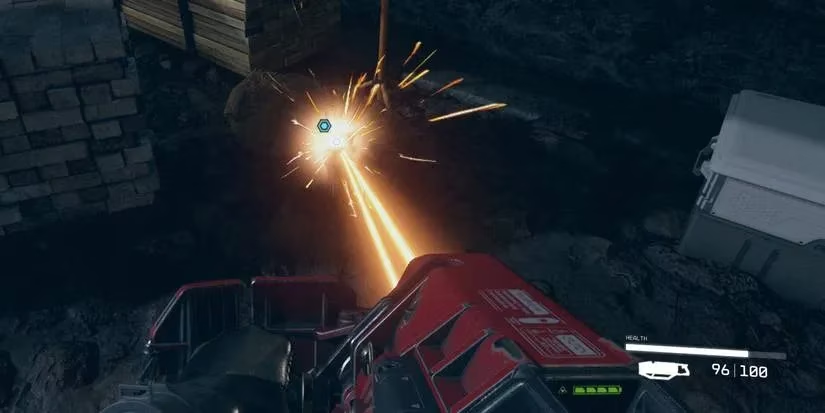
This confluence of factors created an exponentially complex problem. Implementing a robust, convincing gore system that interacted seamlessly with a near-infinite combination of suit types and body morphs threatened to consume development resources better spent on polishing the core galaxy-spanning experience. The studio faced a choice: pursue a technically fraught feature that could compromise stability, or streamline the violence to ensure the universe itself felt whole, responsive, and vast. They chose the latter. The silence of a vacuum replaced the squelch of torn flesh, a different kind of awe settling over the battlefield.
Legacy and the Future: Mods, Sequels, and New Engines
With the game's critical and financial success solidified by 2026, and its first major expansion, Shattered Space, having already enriched the narrative cosmos, the question of this lost carnage persists. Mejillones's insights effectively rule out Bethesda officially adding such a system in future updates—the foundational architecture wasn't built for it. However, the torch may yet be passed. The modding community, ever the architects of alternate realities, could take a stab at this digital frontier, weaving gore back into the fabric of the Settled Systems through sheer ingenuity. 💻
Looking beyond the present, the success of Starfield naturally fuels dreams of a sequel. While Bethesda remains officially silent, former staff speculate it could be one "hell of a game," precisely because it would have the opportunity to address foundational feedback from the first outing. Could a Starfield 2, built with years of hindsight, finally solve the suit-and-gore conundrum? Some former developers even suggest a more radical shift: abandoning the Creation Engine for the formidable capabilities of Unreal Engine 5. Such a move could theoretically provide the advanced rendering and physics tools needed to realize that initial, bloody vision without the "rat's nest" of technical debt.
| Aspect | Original Vision | Released Reality | Future Potential |
|---|---|---|---|
| Violence & Gore | High, with dismemberment | Streamlined, impact-based | Modding community or sequel with new engine |
| Technical Hurdle | Space suit complexity | Suit design simplified systems | UE5 could offer new solutions |
| Development Focus | Feature completeness | Universe stability & scale | Addressing first-game feedback |
Thus, the story of Starfield's violence is not one of absence, but of translation. The raw, physical horror was transmuted into the existential scale of the cosmos itself—the violence of a ship exploding silently against the infinite black, the peril of a forgotten moon's atmosphere. It is a quieter poetry, but a poetry nonetheless. The ghost of that bloodier universe still drifts among the stars, a reminder that every creation is a universe of possibilities, and what we experience is but one path charted through an infinite nebula of what could have been.