
In the vast, sprawling worlds of role-playing games, the journey of a character is a delicate, living thing. It breathes with the choices of the player, shaped by the invisible hands of the progression system that defines its very bones. This system is the quiet architect of every adventure, the silent storyteller that whispers of growth and decay. While some worlds are built for boundless ascension, others find their deepest meaning in the paths not taken, in the roads forever closed by the weight of a choice. For the upcoming Elder Scrolls 6, this fundamental truth about character growth stands as its most sacred design pillar, a lesson learned not just from its own lineage, but from the stellar, yet contrasting, example of its sibling, Starfield.
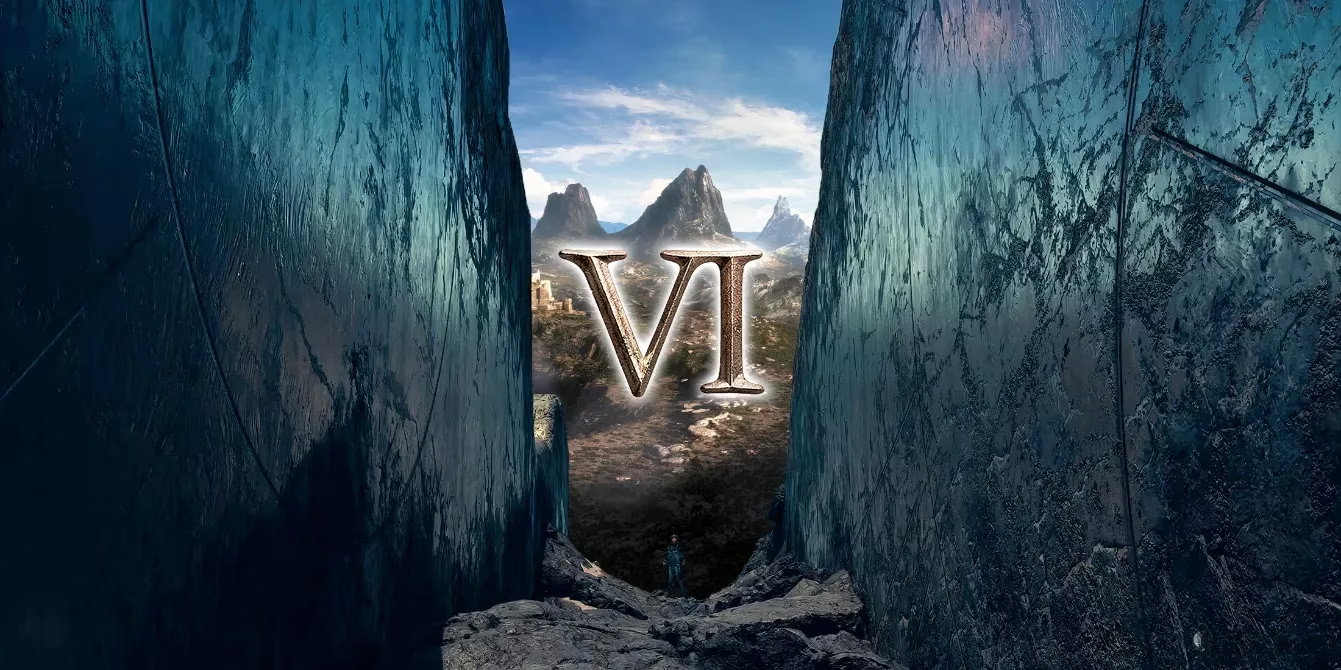
The Unbound Cosmos vs. The Grounded Realm
Starfield, in its cosmic ambition, presents a universe without end. Its progression is a testament to infinite possibility, a system where there is no level cap and the New Game Plus model allows for a form of perpetual rebirth. Players can, given enough time and dedication, master every skill, becoming a true polymath of the stars. This design is a perfect fit for its core fantasy: the dream of total mastery over a universe meant to be explored in countless dimensions. It's the ultimate power fantasy, and frankly, it just works for that kind of sandbox. You can be a stealthy pirate in one life and a scholarly diplomat in the next, all with the same soul.
However, transplanting this "jack-of-all-trades" philosophy into the soil of Tamriel would be like trying to grow a Red Mountain fire fern in the chill of Skyrim's tundra—it just doesn't belong. The Elder Scrolls series, from its very foundations, has been about commitment. It's about looking at a world brimming with possibilities and saying, "This is who I am." The identity of a character is forged in the fires of limitation. A warrior who cannot cast a simple healing spell feels the weight of that choice in every battle; a mage who eschews heavy armor understands vulnerability intimately. This creates a powerful, immersive connection to the world. If everyone can do everything eventually, well, that connection starts to feel a bit cheap, doesn't it?
Why Constraints Breed Meaning
Let's talk about the magic of a character build. In a constrained system, a build is a story in itself. It's a declaration of intent, a specialized toolkit for interacting with the world. The thrill comes from optimizing within boundaries, from finding synergy between a select set of skills to overcome challenges in a unique way.
-
The Stealth Archer: A classic born from limitation, relying on shadows and a single, deadly skill.
-
The Battlemage: A delicate balance of might and magic, requiring strategic investment in two disparate trees.
-
The Pure Illusionist: A high-risk, high-reward path that foregoes direct damage for manipulation and control.
Now, imagine a world where, after a few hundred hours, your stealth archer can also throw down master-level destruction spells while clad in full Daedric armor. The original identity is lost, dissolved into a homogenous soup of ultimate power. The early-game struggle, the careful planning, it all gets trivialized. The series' progression loses its soul. As the old saying in the Arcane University goes, "A master of all is a master of none," and in Tamriel, mastery of a craft should mean something.
The Case for the Cap and the Weight of Choice
This is where the concept of a level cap becomes not a restriction, but a liberation. A firm cap acts as a guardian of meaningful choice. It tells the player, "Your decisions have permanent consequence." It forces strategic thinking from the very first skill point allocated. Do you invest in Lockpicking to access those hidden chests, or in One-Handed to survive the next dungeon? In a capped system, that choice echoes through the entire playthrough.
| System Feature | Starfield's Approach | Ideal for TES6 |
|---|---|---|
| Level Cap | Nonexistent (Infinite) | Firm, Deliberate Cap |
| End-Game Character | Omnipotent Master of All | Specialized Master of a Path |
| Player Psychology | Collectathon, Completionism | Role-Play, Strategic Identity |
| Replay Value Driver | NG+ Story Variations | Entirely New Builds & Perspectives |
Furthermore, a level cap revitalizes mechanics like respecs. In an infinite system, respeccing is often just a temporary diversion. But with a cap, changing your build becomes a monumental, valuable decision. It's a costly rebirth, a chance to live a different life when your current path has been fully explored, making the act itself a significant narrative event. This naturally encourages multiple playthroughs—not to see slightly altered story beats, but to live as a completely different person within the world. You gotta try it as a brutish Orc warrior once, then come back as a sly Khajiit thief; that's where the real magic happens.
Learning from Other Worlds
The importance of narrative-appropriate power scaling is a lesson seen across the genre. Take a game like Cyberpunk 2077, where the story's central tension—a race against time and a degrading psyche—relies on the player not being an unstoppable god. Overpowering the world breaks the immersion and trivializes the very stakes the narrative sets up. Tamriel, while epic, is also a world of grounded (if magical) struggles. The threat of a dragon, the intrigue of a guild, the mystery of a Daedric Prince—these should feel impactful from start to finish, not become minor annoyances for a maxed-out character.
Forging the Future of Tamriel
In the end, Starfield's progression is a beautiful design for its own purpose: a symphony of limitless potential. But The Elder Scrolls 6 must compose a different melody—one of meaningful limitation. By embracing a level cap and shunning the siren call of infinite skill acquisition, it can return to what made its ancestors so profoundly replayable. It can make every perk a precious commodity, every skill point a moment of role-playing definition. The soul of The Elder Scrolls doesn't live in having it all; it thrives in the poignant beauty of the path chosen, and the haunting whisper of the paths forever left behind. For the next hero of Tamriel, their legend should be defined not by the skills they mastered, but by the person they chose to become.
After all, what's a hero without a few scars and some glaring weaknesses? That's where the real story is.