
The void of space beckons once more, but in the wake of ambitious titles like Starfield, the question hangs heavy in the air: what truly makes exploration feel worthwhile? As 2026 approaches, all eyes are on The Outer Worlds 2, the sequel poised to launch players back into a corporate-dominated cosmos. The first game carved out a memorable niche with its sardonic wit and pulp sci-fi spirit, tasking players with recruiting a crew and navigating a galaxy where boardrooms held more power than governments. Yet, the landscape of spacefaring RPGs has evolved. The challenge now isn't just to provide a universe to traverse, but to fill it with purpose, wonder, and discoveries that feel genuinely earned. Can The Outer Worlds 2 learn from the missteps of its peers and set a new standard for interstellar adventure?
The Pitfalls of Procedural Emptiness
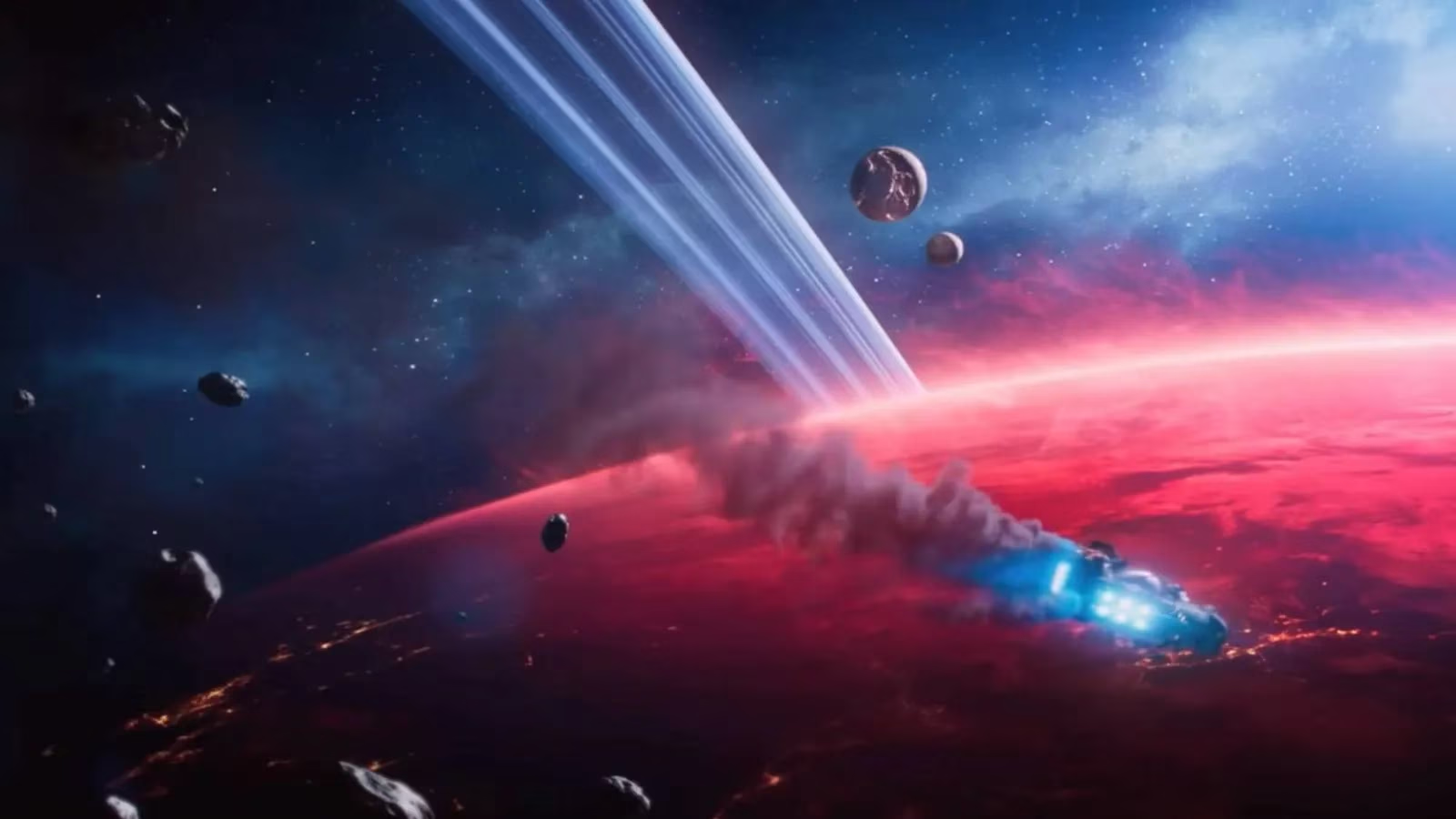
Starfield offered a staggering number of planets, a feat of technical ambition. But for many players, that ambition often collided with a cold reality: quantity did not guarantee quality. Countless worlds felt barren, serving as little more than resource depots with procedurally generated terrain. The experience could become thankless; why chart a new course when the destination promised only more of the same rocks and outposts? This was a key disappointment in an otherwise expansive game. The Outer Worlds 2, therefore, faces a critical mandate. It must ensure that every landing site, every new horizon, offers a compelling reason for players to disembark from their ship. The sequel cannot afford to repeat the sin of empty vistas. It needs to ask: what secrets lie beyond the atmosphere that are worth the journey?
Building on a Foundation of Purpose
Fortunately, the original The Outer Worlds already demonstrated a strong blueprint for meaningful exploration. Every region players could visit was hand-crafted with intent, woven into the narrative through quests, unique characters, and environmental storytelling. Players weren't just wandering; they were investigating corporate malfeasance, aiding colonies, and uncovering bizarre experiments. The sequel has a perfect opportunity to expand this philosophy on a galactic scale. By introducing more planets and diverse biomes than its predecessor, The Outer Worlds 2 can create a richer tapestry of experiences. Imagine the possibilities:
-
Frozen Tundra Planets: Where survival mechanics meet tales of abandoned research stations.
-
Fungal Jungles: Teeming with bizarre flora and fauna, hiding relics of pre-corporate civilizations.
-
Acidic Rainforests: Where environmental hazards shape both the landscape and the stories of its inhabitants.
A wider variety of landscapes naturally leads to more interesting setpieces, hidden treasures, and quests that feel uniquely tied to their environment. The goal is to make players want to see what's over the next ridge, not because a map marker tells them to, but because the world itself is whispering of untold stories.
The Wild Card: Science as a Tool for Discovery
What if exploration itself could be fundamentally altered by the game's signature sardonic science? The first game's 'Science Weapons' were legendary for their bizarre, rule-breaking effects in combat. The Outer Worlds 2 could apply this same creative philosophy to the very act of exploring. Planets or zones with unique, science-gone-wild properties could transform navigation into a puzzle and discovery into a thrill. Consider the potential:
| Planetary Phenomenon | Exploration Gameplay Twist |
|---|---|
| Localized Gravity Wells | Areas of extreme low or high gravity, requiring specialized gear or clever use of jetpacks to traverse. |
| Temporal Flux Zones | Where time moves erratically, revealing glimpses of the past or future of a location. |
| Phase-Shifting Terrain | Solid ground that becomes intangible, forcing players to find frequency modulators to 'solidify' their path. |
| Biological Light-Synthesis | A planet where flora emits light so intense it can be harnessed for platforming or solving environmental puzzles. |
These aren't just visual gimmicks; they are integral tools that challenge the player's understanding of the game world. Finding a 'Gravity-Nullifier' science tool on one planet could be the key to accessing a hidden cavern on another. This approach makes exploration systemic, creative, and deeply tied to the game's identity. A dash of wild science could indeed be the secret weapon that makes every planet feel like a unique experiment waiting to be unraveled.
The Final Frontier: A Legacy to Forge
Space is the ultimate canvas for adventure, and The Outer Worlds 2 has the chance to paint a masterpiece. It stands at a crossroads, with the lessons of the past clearly visible. The first game was a brilliant proof of concept—a compact, witty adventure. Starfield, for all its scope, highlighted the perils of scale without soul. Now, with an established framework and the benefit of hindsight, the developers have the room and the responsibility to push further. The sequel must blend the hand-crafted purpose of its predecessor with a grander, more creatively chaotic universe. It needs to ensure that stepping onto a new world is always a moment of anticipation, not a routine chore. If it succeeds in making exploration feel genuinely exciting, meaningful, and unpredictably fun, The Outer Worlds 2 won't just be a successful sequel. It will launch itself into the stars as a defining benchmark, setting a course that future sci-fi adventures will strive to follow for years to come. The corporate galaxy awaits—will it be worth the price of admission? 🚀