
I’ll be honest: when Bethesda first pitched Starfield as a galaxy with roughly 1,000 planets spread across 100 star systems, I imagined a universe of endless discovery. In practice, the base game often felt like a mile-wide, inch-deep sandbox. That’s exactly why Shattered Space, the game’s first major expansion, still matters in 2026: it trades that unfocused scale for one strange, dangerous, and beautifully handcrafted planet.
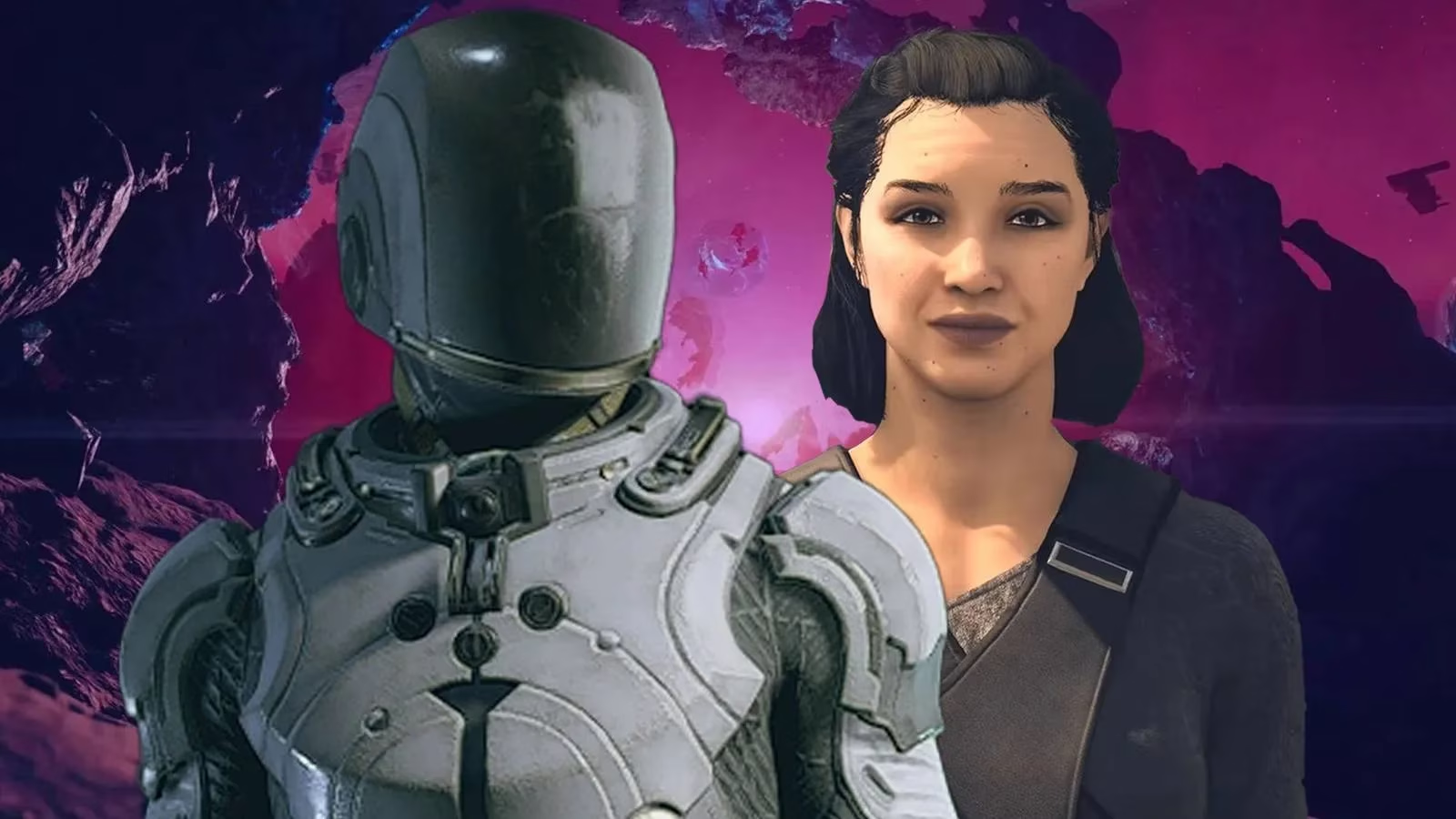
The expansion turns its attention to House Va’ruun, the third interstellar government to form in the Settled Systems. Players finally visit Va’ruun’kai, the faction’s homeworld, and its capital city Dazra. Available through Starfield’s Premium and Constellation Editions or as a standalone purchase, Shattered Space is a self-contained story that leans far harder into horror than the main game ever did.
By the time I stepped onto Va’ruun’kai, the place was in shambles. Two weeks earlier, House Va’ruun had experimented with grav drive technology, and the result was catastrophic. Dazra had been destroyed, large portions of the planet were cut off, and gravitational distortions called Vortexes now split the landscape into surreal, isolated pockets. The Va’ruun leader had vanished, factions were scrambling for control, and extra-dimensional monsters were spilling through those Vortexes like uninvited guests.
🧭 Here’s why the single-planet focus works:
-
🪐 Dense handcrafted design instead of procedural sprawl
-
👾 A horror tone that gives Va’ruun’kai a haunted identity
-
⚔️ Political factions that make the mystery feel alive
-
🌀 Extra-dimensional monsters that add constant pressure
That setup gives Shattered Space a much stronger emotional and mechanical focus. Instead of asking players to hop between dozens of empty procedural worlds, Bethesda built the new missions almost entirely across one planet. I won’t pretend that a single-planet expansion sounded exciting at first. After all, Starfield’s main selling point was its enormous map. But the handcrafted locations in the base game—from the Western-inspired Akila City to the neon-drenched streets of Neon and the clean, utopian lines of New Atlantis—always had more personality than the randomly generated spaces around them. Va’ruun’kai continues that tradition. Its architecture feels deeply alien, and its ruined capital gives the expansion a haunted, oppressive atmosphere.
Xbox Wire previews described the expansion as “looking and feeling like a classic Bethesda Game Studios experience, similar to prior expansions for The Elder Scrolls and Fallout series.” That’s the best possible sign. Those expansions often worked because they were smaller, stranger, and more tightly written than the main campaigns. Shattered Space follows that blueprint: a self-contained story that plays with tone and mechanics the base game didn’t explore. The horror flavor isn’t just a coat of paint. The Vortexes, the political infighting, and the mystery of the missing leader create a genuine sense of dread and urgency.
The base game’s biggest criticism was that exploring 1,000 planets sounded impressive but often felt empty and lifeless. In theory, those blank canvases were meant for outpost building and resource mining. In practice, they made exploration feel more like a chore than an adventure. Starfield has improved since launch—land vehicles made traversal much more enjoyable, for example—but no amount of faster driving can fix a destination that isn’t interesting to begin with. Shattered Space is the opposite. It gives players a dense, weird, dangerous place and lets the story breathe.
For me, Va’ruun’kai is proof that Bethesda still knows how to build an unforgettable world when it isn’t trying to fill an entire galaxy. The expansion’s deeply alien landscape and unique architecture reward players who want to poke around every corner, read every terminal, and learn more about House Va’ruun’s lore. The political factions wrestling for power add texture, while the Vortexes keep the tension high. It’s a step in the right direction—and a template I hope future Starfield updates and expansions keep following.
If the next chapter gives me another world this dense, I’ll happily leave the other 999 planets alone for a while.