
In the vast, starry expanse of gaming in 2026, few topics still generate as much heated, meme-filled debate among the space-faring crowd as the legacy of Starfield and its, let's say, intimate relationship with loading screens. Detractors have long pointed to the game's onerous transition sequences as a major immersion-breaker, a stark contrast to the seamless worlds of titles like Cyberpunk 2077. While a clever mod emerged to patch up Neon City, it really just put a neon-colored band-aid on a much deeper, engine-level wound for Bethesda. It's the gaming equivalent of using duct tape to fix a starship's grav drive—it might hold for a bit, but you're not getting to Alpha Centauri that way.
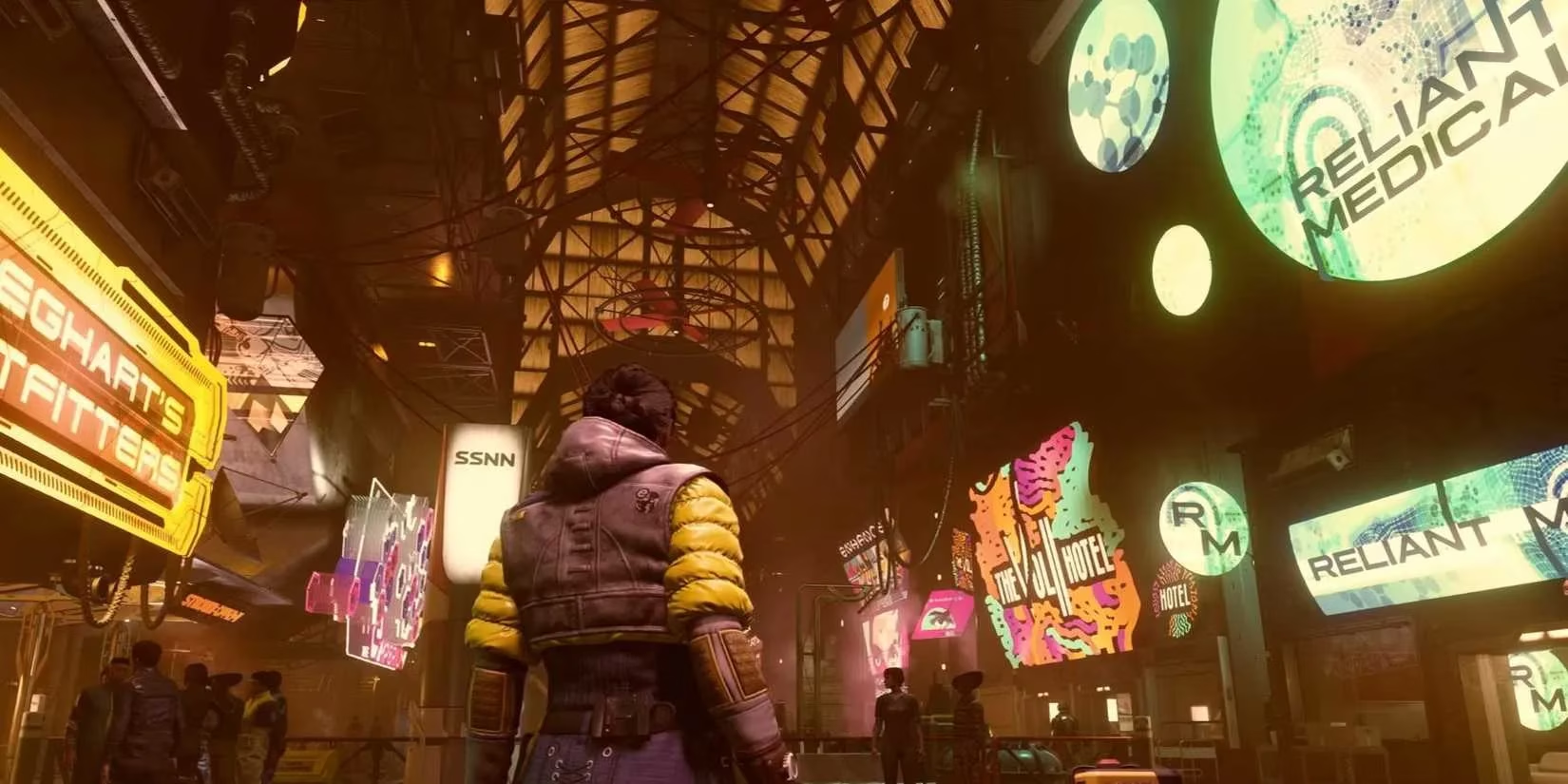
The hero of this particular tale was the 'Seamless City Interiors' mod by PanConKeso. This digital wizardry essentially hacked Neon, turning its interior cells into exterior ones, allowing players to stroll from the rainy streets right into the seedy bars without that infamous 'Please Stand By' moment. The modding community and players gave it a solid 'LFG!' (Let's Freaking Go!), but it raised a massive, blinking question mark: Why on Earth (or Jemison) hadn't Bethesda done this themselves? 🤔 The mod worked decently on PC, but the console crowd, especially those on the Xbox Series S, were left wondering if their hardware could even handle such sorcery.
Let's break down the core issue, and no, you don't need a degree in rocket science or C++ to get it. The prevailing theory among armchair engineers is that the Creation Engine has a foundational 'quirk': it loves to bulk-load everything in an area all at once. Think of it as a very enthusiastic but clumsy party host who tries to carry the entire buffet table into the living room in one trip, inevitably needing to stop at the door to rearrange the plates. When an area has hundreds or thousands of interactive items (a Bethesda trademark), the engine just goes 'Nope, loading screen time!'
| Bethesda's Creation Engine Approach | Modern Engine Ideal (e.g., REDengine, UE5) |
|---|---|
| Bulk-loads entire areas/levels | Procedurally streams assets as you move |
| Requires frequent loading screens for transitions | Aims for seamless, open-world traversal |
| A legacy of the Gamebryo engine foundation | Built for contemporary hardware and design |
This isn't exactly new for Bethesda veterans. We've all grown accustomed to these 'Bethesdaisms'—the jank, the charm, the loading doors. But in Starfield, with its promise of a boundless cosmos, these pauses felt more jarring than ever. The engine, while improved since Fallout 4, seems to pale in comparison to modern counterparts. Frankly, it makes some fans 'scared for the new Elder Scrolls', fearing it might continue this dated practice instead of delivering a truly immersive, seamless world.

The comparison to CD Projekt Red's REDengine (RIP, as they've moved to Unreal 5) is particularly damning. Cyberpunk 2077's Night City is a benchmark for dense, seamless urban exploration. Meanwhile, Unreal Engine 5 has shown insane flexibility for developers. Even other proprietary engines, like Larian's Divinity 4.0 engine used for Baldur's Gate 3, demonstrate that a company can build a highly specific, powerful tool that perfectly serves its vision. The Creation Engine, in this company, can sometimes feel like it's running on 'vibes and legacy code.'
Now, let's be clear: swapping the engine isn't a magic bullet. The die-hard fans' old mantra—'Bethesda games are just different!'—has some truth, but the real issues run deeper. Many agree that Starfield's problems were also about:
-
📜 Stale Storytelling: What once felt fresh now feels formulaic.
-
🎮 Lack of Meaningful Choices: Where's the risk-taking?
-
🔄 Overly Safe Design: A sense of playing it too safe.
Starfield was technically impressive but arguably one of Bethesda's most divisive games because it highlighted these creative and technical limitations in HD. The loading screens were just the most visible symptom.
So, what's the verdict in 2026? The Neon mod was a fantastic community 'fix,' but it was a workaround, not a solution. It highlighted that without a fundamental shift in Bethesda's tech foundation—or a massive, innovative overhaul in both design and storytelling—players might be facing more loading screens in Tamriel than they'd like. The galaxy may be infinite, but patience for loading screens? That's a very finite resource. 😉