
As Starfield marks its second anniversary in 2026, the conversation around Bethesda's ambitious space-faring RPG continues to evolve. The developer has hinted at plans to spin Starfield into a longer series, potentially positioning it as a third franchise pillar alongside the iconic Elder Scrolls and Fallout series. Yet, the journey has been notably different. While Starfield launched with immense hype, it quickly became one of Bethesda's most contentious releases, surrounded by a cloud of disillusionment over its mechanics and perceived sparse world design. The fervor for a new Starfield installment doesn't quite match the palpable excitement for The Elder Scrolls 6 or Fallout 5. Some players even argue that Fallout, with its compelling, energetic post-apocalyptic open world, remains the superior sci-fi alternative. However, a closer examination reveals a compelling counterpoint: for long-term growth and narrative potential, Starfield's foundation may be far more robust and expansive than Fallout's.
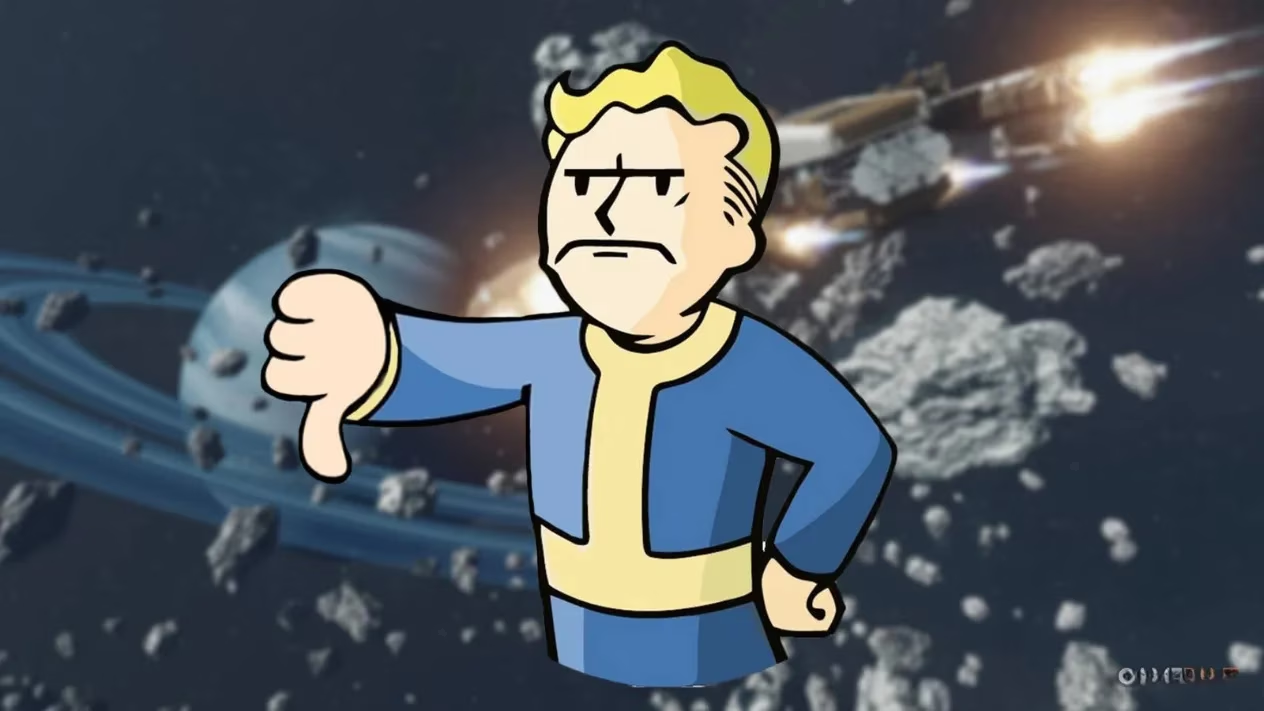
The debate often centers on worldbuilding. It's easy to critique Starfield's initial, somewhat toothless sci-fi setting when held against Fallout's rich, iconic, and deeply textured lore born from nuclear devastation. Fallout's world is a character in itself—a brutal, ironic, and strangely beautiful landscape defined by strife, scarcity, and the constant shadow of mortal danger. Yet, this very strength introduces a fundamental constraint. The Fallout franchise is intrinsically tied to a specific premise: the slow, painful re-emergence of civilization centuries after a global nuclear war. This story is not only geographically restrained, being unmistakably America-centric, but also temporally bounded.
The Inevitable Expiration Date of a Post-Apocalyptic World
The residents of Fallout's wasteland are caught in a pivotal moment. After generations of scraping by, they face a critical juncture: will they advance toward more stable agriculture, industry, and comfort, or will the relentless struggle for survival cause a regression into barbarism? This civilization, by its very nature, cannot remain static. The 'post-apocalyptic' state has a shelf life. This creates a narrative ceiling for the franchise. How many centuries into the future can the series progress before it becomes an entirely different genre—a story of a rebuilt society rather than a struggle in the ashes? The setting necessarily limits the kinds of stories Bethesda can tell, anchoring them to a specific tone, technology level, and societal structure.
Contrast this with the canvas of Starfield. 🚀
While the first game's execution was criticized—most notably for its vast array of over 1,000 procedurally generated planets leading to exploration that could feel trite—this ambition points directly to the series' core strength: limitless potential. Starfield is not confined to one planet, one solar system, or even one era. Its narrative framework is astronomically broader. The first game introduced players to the mystery of the Starborn and the settled systems, but that is merely one chapter in a universe of possibilities.
| Franchise | Primary Constraint | Narrative Scope |
|---|---|---|
| Fallout | Geography & Time (Post-Apocalyptic Timeline) | Limited, must adhere to core premise |
| Starfield | (Effectively) None | Limitless, spans planets, factions, and eras |
Future Starfield games are free to explore entirely new conflicts and stories. A sequel could pivot from cosmic mysteries to a gritty rebellion on a remote mining colony. Another could delve into a political thriller centered on corruption at the height of New Atlantis's power. A third might explore first contact with a truly alien civilization. The setting allows for stories ranging from intimate character dramas to galaxy-spanning wars, all without breaking the foundational logic of the universe.
The key to unlocking this potential lies in creative restraint—a lesson Bethesda seems poised to learn. The initial Starfield aimed to be the definitive space RPG by emphasizing sheer scale and freedom, arguably at the expense of curated depth and compelling moment-to-moment gameplay. Future installments don't need a thousand planets; they need a handful of meticulously crafted, dense, and relevant worlds. By focusing on stronger narratives, deeper faction systems, and more dynamic gameplay within a smaller, richer slice of the galaxy, the series can fully realize the promise of its setup.
In essence, Fallout is a masterfully told story set within a brilliant, but ultimately finite, box. Starfield, for all its initial missteps, offers an entire universe of blank pages. Its potential for long-term growth, reinvention, and exploration across genres and themes within the sci-fi umbrella is unparalleled in Bethesda's portfolio. As the studio looks to the future, the boundless frontier of Starfield may well prove to be its most valuable asset. 🌌 The journey has just begun, and the galaxy awaits its next great story.