
As I reflect on the state of Starfield in 2026, it's clear the game is at a crossroads. The inaugural Shattered Space expansion, while a step forward, felt like a carefully calibrated course correction—a necessary but somewhat predictable jump to a new star system. The community's appetite, however, craves something more transformative, a leap into the unknown that rekindles the unique magic we associate with Bethesda's best work. The studio's past commitment to annual expansions hangs in the air, a promise yet to be fully realized, and all eyes are now fixed on the horizon for the next major content drop. The path forward, I believe, isn't just in charting new nebulae, but in daring to embrace the playful, almost mythic storytelling that made titles like Skyrim legendary.
The Missing Spark: Starfield's Reality vs. Bethesda's Legacy
One of the most persistent critiques since launch is that Starfield, for all its technical ambition and scale, lacks the signature Bethesda spark. Its hard sci-fi foundation is admirable, a sprawling cosmic diorama built with scientific plausibility in mind. Yet, this very commitment can make the universe feel strangely sterile, like a meticulously organized laboratory compared to the lived-in, chaotic taverns of Tamriel. Past projects, even with older technology, fostered worlds that felt richer with dynamic, often bizarre, interactions. The Settled Systems are vast, but they can sometimes feel like a gallery of impressive but static exhibits, missing the unpredictable life that turns a game world into a home for players. The recent improvements have been welcome, but they've often addressed systemic issues rather than injecting new soul.
The Dawnguard Blueprint: A Lesson in Playful Choice
This is where looking back becomes essential for moving forward. Skyrim's Dawnguard expansion wasn't just about adding new quests or a dungeon; it was about offering a profound, identity-shifting choice. Players could align with the noble Dawnguard or succumb to the dark allure of vampirism, fundamentally altering their gameplay and role in the world. It was a masterclass in playful, consequential storytelling. Starfield has its own intriguing lore cornerstone in the Starborn—humans transformed by passing through the Unity. It's a fascinating concept, but currently, it feels more like an end-state title than a dynamic, ongoing condition. The transformation lacks the immediate, tangible feedback and role-playing depth of becoming a vampire lord or a werewolf.
Starfield desperately needs its own version of this paradigm shift. The potential is cosmic. Imagine encountering a mysterious, ancient alien hive-mind and choosing to partially integrate with it, gaining telepathic abilities but becoming hunted by purist factions. Or, leaning into a more gothic space opera vein, discovering a reclusive order of "Void-touched" beings—not magical vampires, but humans altered by prolonged exposure to a strange gravitational anomaly or exotic particle field, granting them unique powers at a terrible cost. This would be more than a new skill tree; it would be a new way of being in the universe, altering faction relations, dialogue options, and even the environment's reaction to the player.
Beyond the Starborn: Crafting a Living, Breathing Universe
The Starborn are a great narrative device, but they are, by their nature, somewhat removed and philosophical. The game needs more immediate, visceral forms of transformation and conflict. The lack of common, humanoid alien life remains a glaring omission, making the cosmos feel oddly human-centric. Introducing a sentient, space-faring species—not just as enemies or distant lore, but as a civilization with which players can forge complex alliances or rivalries—would add an entire new layer of political and social intrigue. These interactions shouldn't be clean and diplomatic; they should be messy, surprising, and sometimes horrifying, much like stumbling upon a Daedric Prince's realm for the first time.
Bethesda's strength has always been in creating worlds that feel like they exist beyond the player's gaze. Starfield's procedural planets are like endless fields of scientifically accurate wildflowers—beautiful in aggregate but often lacking the distinct, hand-crafted charm of a single, unique bloom. The next DLC must prioritize hand-crafted content that tells a compelling, self-contained story with lasting repercussions. It needs moments that feel earned and strange, where the line between advanced technology and cosmic wonder blurs.
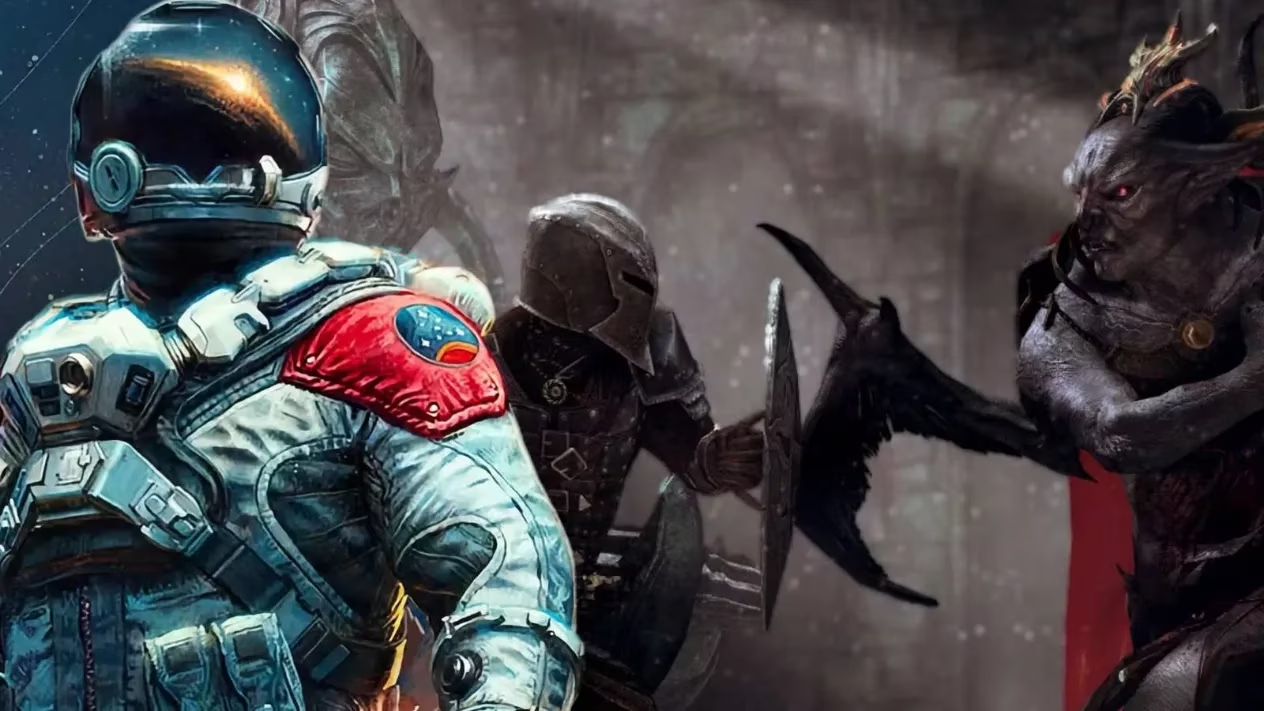
The gothic, choice-driven conflict of Skyrim's Dawnguard (pictured) offers a template Starfield could creatively adapt for its own universe.
The Path Forward: Whimsy as a Catalyst
After the tempered response to Shattered Space, it's likely Bethesda is carefully reconsidering its strategy. The studio has been quiet, which can be agonizing for fans but also suggests thoughtful recalibration. The upcoming Xbox showcases present the perfect opportunity for a course reveal. For Starfield to truly ascend and carve out its own legendary status alongside Morrowind, Oblivion, and Skyrim, it must be willing to inject a calculated dose of whimsy and wonder back into its cosmic recipe.
This isn't about abandoning its sci-fi roots for fantasy. It's about recognizing that the most memorable science fiction often flirts with the mystical and the unexplained. It's about understanding that a player's desire to be a pragmatic space explorer can coexist with a secret longing to become something... more. Something unexpected. The Settled Systems need their own myths and monsters, not just corporate contracts and mineral surveys. The next expansion shouldn't just be another chapter; it should be a new genre for the player to experience within the same game.
In essence, Starfield's universe is currently like a symphony played with perfect technical precision but missing the one wild, improvisational solo that makes the audience hold its breath. The Dawnguard expansion was that solo for Skyrim—a bold, thematic riff on its core fantasy. Starfield's next DLC needs to find its own unique riff, a concept so playful and transformative that it doesn't just add to the game, but fundamentally recontextualizes what it means to play it. The mystery of what's next is palpable, but the hope is that when Bethesda finally breaks the silence, they bring not just a new star to visit, but a new way to see the entire cosmos.
Data referenced from SteamDB helps contextualize how a major Starfield expansion could reignite momentum by offering more than new locations—especially if it introduces a Dawnguard-style identity fork where players opt into a transformative “condition” with systemic consequences. Tracking player activity trends and update impacts underscores why a DLC that reshapes role-play loops (faction reactions, traversal/combat perks, and persistent drawbacks) may land harder than another content drop focused mainly on exploration breadth.