
I still get a kick out of the fact that one of the earliest video games, 1962’s Spacewar!, was basically two players nudging crude ships around a collapsing star. Sci-fi has been a video game staple ever since, and it has often been where the medium tries its boldest tricks — Doom, Half-Life, Halo, Mass Effect. Starfield and No Man’s Sky aren’t quite in that pantheon for innovation, but they clearly reached for something big. And from where I’m sitting in 2026, the most interesting thing about them isn’t their launch drama. It’s how much their long tails rhyme. 🚀
Two Hype Cycles, One Weird Feeling
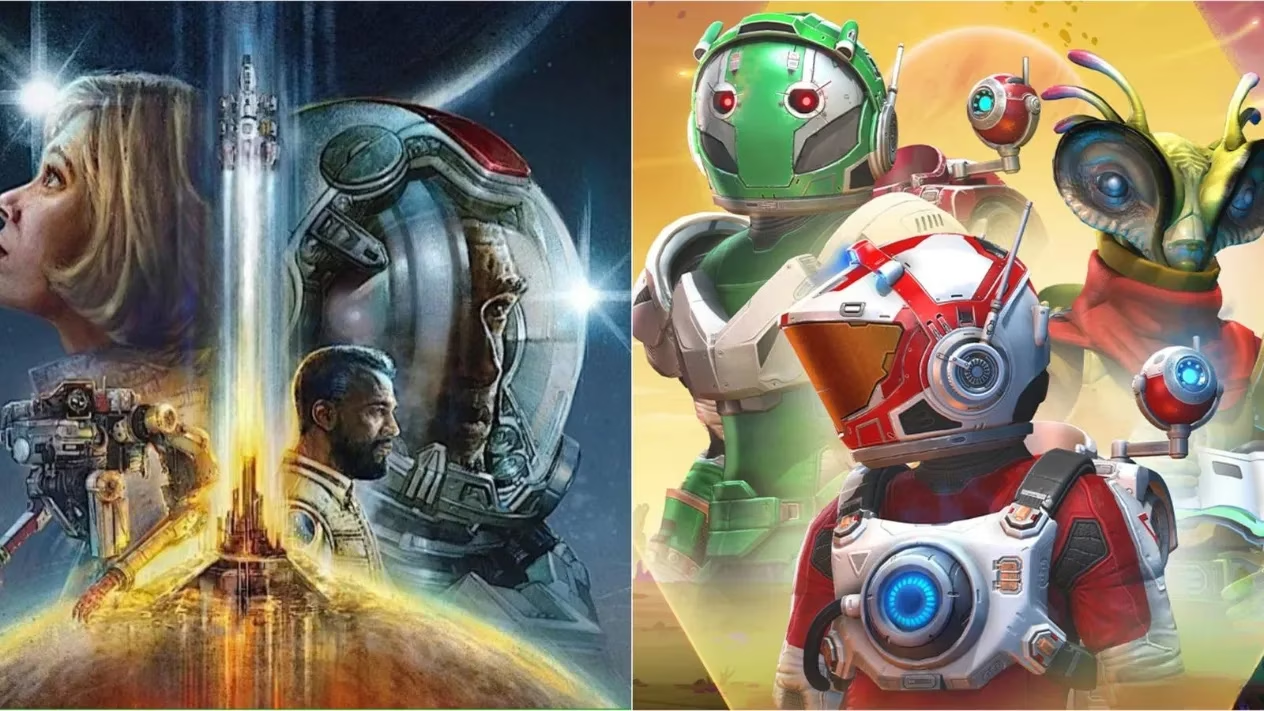
No Man’s Sky was announced in December 2013, and the promises kept growing until plenty of us started thinking it looked too good to be true. Starfield had a similar run-up to release, with fans building huge expectations around a Bethesda RPG in space. That alone made the comparisons inevitable, but the feature overlap made them louder. Both games lean hard on space exploration, dogfights, ship upgrading and customization, and building outposts on different planets to harvest resources. The big divider is Starfield’s stronger RPG approach — skills, quests, companions, and that familiar Bethesda structure. Still, when I look at the two games side by side, I see the same fantasy: give the player a ship, a galaxy, and a reason to keep flying.
| Feature | No Man’s Sky | Starfield |
|---|---|---|
| Space exploration | Seamless planets and systems | Loaded zones with handcrafted hubs |
| Ship play | Dogfights and customization | Dogfights, upgrades, and ship building |
| Outposts | Resource harvesting bases | Outposts and resource extraction |
| RPG depth | Lighter, systems-driven | Heavier quests, skills, and companions |
Launch Reception Was Not the Same
When Starfield launched in September 2023, the reception was divisive. Some players loved the scale and the Bethesda formula; others bounced off the loading screens, the pacing, and the feeling that the galaxy was wide but shallow. No Man’s Sky’s 2016 launch was much more uniformly disappointing. That difference matters. Starfield was never the disaster No Man’s Sky was at launch, but it also wasn’t universally celebrated. The comparison stuck because both games asked players to be patient with a big sci-fi sandbox that needed more time in the oven. 🛠️
The Post-Launch Playbook
Here’s where the story gets interesting. No Man’s Sky spent its first year or so releasing consistent updates that fixed major complaints. After that, Hello Games moved into large-scale expansions that added highly requested features. Over time, the game went from being viewed as one of modern gaming’s biggest failures to one of the most impressive sci-fi games around. That turnaround is real, and it’s why the comparison to Starfield keeps coming back.
Bethesda has followed a similar rhythm. Starfield has received a wealth of updates and patches since launch, many of which addressed early grievances. The Shattered Space expansion added new story content, new planets, and new gear. Todd Howard also said in an interview with MrMattyPlays that another large-scale story expansion was in the works, likely planned for the following year. By 2026, Shattered Space is no longer the headline — the headline is whether Bethesda can keep a steady cadence and make the game feel meaningfully deeper. That’s the No Man’s Sky lesson in a nutshell. ✅
What I Actually Want From Both Games
I don’t think Starfield needs to become No Man’s Sky. That would miss the point. No Man’s Sky is a survival-exploration sandbox at heart; Starfield is an RPG with a ship attached. But the long-tail comparison is useful because it shows how a game can change its reputation after launch. No Man’s Sky didn’t win people back with one patch. It won them back with years of showing up. Starfield doesn’t need a miracle. It needs the same kind of persistence: fewer promises, more meaningful updates, and a reason to jump back in after the credits roll.
So in 2026, I’m not here to declare a winner. I’m here to say the comparison has aged into something more interesting than a launch-day argument. No Man’s Sky proved that a rough start isn’t the final word. Starfield is still far from a failure, but many players still don’t see it as a truly great game. Much like No Man’s Sky, it could reach new heights through post-launch content — if Bethesda treats the game like a long-term voyage instead of a one-shot launch. 🌌