
Let me tell you, folks, it’s 2026 and I just clawed my way through Starfield: Shattered Space like a caffeinated raccoon in zero-G. Holy moly, this DLC didn't just push my moral compass—it grabbed it by the thrusters and yeeted it into a black hole. Every single choice in this expansion felt like the universe was asking, “Hey you, yes you with the itchy trigger finger, what’s your core value system? Oh, you don’t have one? Too bad, now you do.”
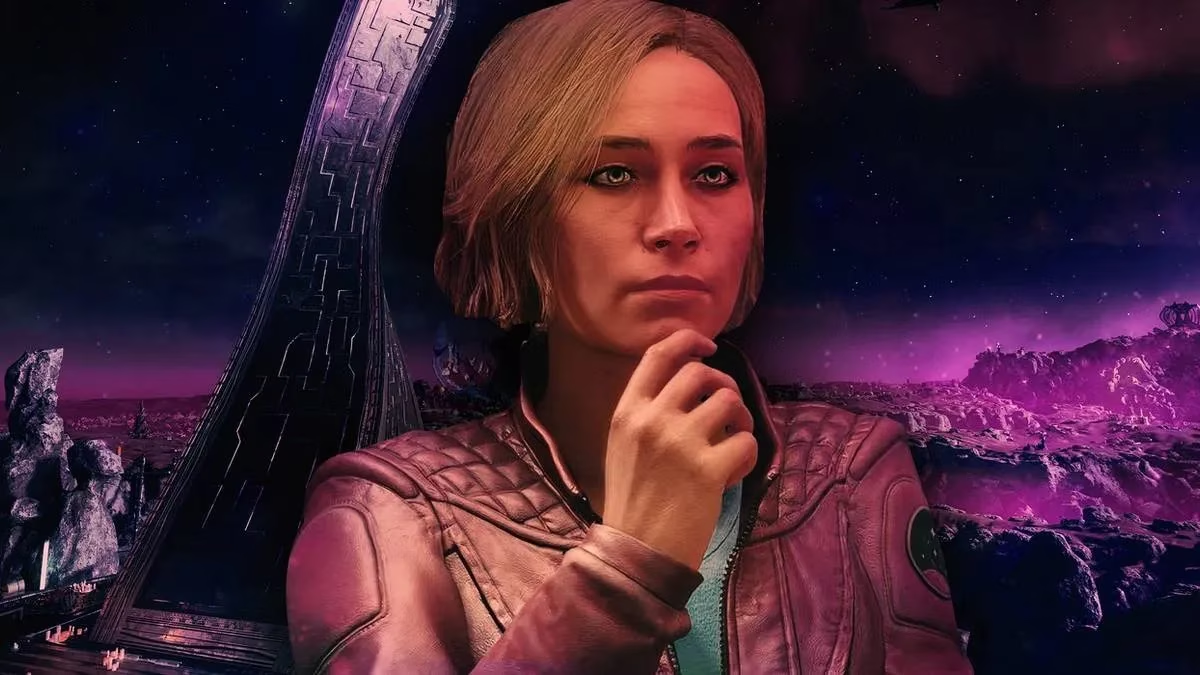
That image up there? That’s exactly the face I made when I first stared at the vortex interlock in the “Exhuming the Past” mission. Brother, talk about a nightmare wrapped in an existential crisis. On one hand, I could yank that thing out and stroll out of the dam like a boss, no fisticuffs with those creepy vortex phantoms. Sweet, right? Wrong. Yanking it flooded a whole freaking town. I mean total devastation—homes gone, lives shattered, tears for breakfast. But wait, I’d get a cool 12,000 credits, special gear, and enough XP to make my character do a happy dance? That’s what you call a moral fork in the road, and it tested whether I was a heartless credit-grabber or a masochist who preferred getting my teeth kicked in by phantoms for the greater good. I chose the chaotic exit, because apparently I love pain, and the guilt of wiping out a town would’ve haunted me more than a ship full of space ghosts.
Then came the big political circus—picking which House would rule Va’ruun’kai: Veth’aal, Dul’kehf, or Ka’dic. Talk about pressure, amirite? It’s like choosing the next president of the galaxy’s most unstable civilization while everyone judges you with laser eyes. I went with House Dul’kehf, and when Mallibir Dul’kehf said, “Then so it shall be,” I felt the full weight of an entire planet drop on my shoulders. I snagged the Vacant House (nice real estate, by the way), but I also knew that my decision would ripple through the storyline like a seismic shockwave. The alternative? Pick none and become public enemy number one, lose my house in Dazra, and basically light the planet on fire with internal strife. No, thank you, I like having a roof and not being hunted.
Oh, and let’s not forget the gut-wrenching dilemma in “Conflict in Conviction” with Vaeric. This dude was a wanted traitor, and Viktor was practically drooling for his blood. Killing him was the easy route: credits in the pocket and a pleased Viktor. But hold the phone—doing that utterly destroyed his family, especially his mom Vitoria, and turned the entire Veth’aal household into a pack of fuming haters. Long-term benefits? Poof, gone. So I spared him, then persuaded him to return home like a reverse therapy session. Boom, positive relations, the same base rewards, and I could look myself in the mirror. Not gonna lie, that felt epic. Morality for the win, baby!
Then there was Sahima in “Zealous Overreach.” The zealots had her, and the choice was: execute her or save her. Killing her snapped ties between zealots and House Ka’dic so hard it triggered immediate chaos. But rescuing her? That let her expose the zealots’ schemes, handed me better loot, and led to a peaceful resolution. Plus, my companions actually liked me afterward—imagine that! If you’re gunning for a playthrough that doesn’t make you feel like a space jerk, this is a total no-brainer. But if you’re riding the chaos train, choo-choo, go ahead and paint the walls red.
And speaking of brain-melting decisions, the Scaled Citadel quest hit me with either destroying the Modulator or overloading the Vortex Gate. I’m going to be real with you: both paths led to the same ending, but the difficulty difference was straight-up bonkers. Destroying the modulator meant shooting it over and over while a timer screamed at me. Overloading the gate? That required disabling shields and throwing down with Anasko like some interdimensional cage match. I chose the latter because I’m a glutton for punishment, and let me tell you, my combat skills were tested to the absolute limit. Strategic planning? More like panic-sweating and button mashing. But I escaped the Citadel, barely alive and definitely cooler.
Now, the real kicker—the Serpent Crusade. This was the galaxy’s version of a big red button labeled “Do Not Push.” After I helped elevate House Va’ruun’s speaker, they asked if I wanted to resume the crusade or squash it. Support it? Congrats, you get a sweet home on Va’ruun’kai, but now you’re the poster child for interstellar genocide. Preventing it meant no bloodshed and a future of peace, putting me in the pages of galactic history as the chill diplomat who said “nah” to mass destruction. I went with peace, obviously. My character now walks through the Settled Systems getting pats on the back instead of angry mobs. The moral clarity? Chef’s kiss.
And the cherry on top: I could’ve walked away from picking any House and exiled myself from Dazra, leaving Va’ruun’kai in a doomed limbo of backstabbing and chaos. What a way to end a storyline—ride off into the sunset labeled a traitor by everyone. Nah, I stuck around and shaped the future, because apathy is so last century.
Then in the same Scaled Citadel quest, I had to decide whether to release the Phantoms or terminate their life support. Releasing them was Anasko’s evil masterplan, unleashing chaos across the Settled Systems, and leading to a gnarly showdown. Terminating them was arguably merciful—they were innocent before Anasko’s meddling—but oh, the ethical nightmares! I chose to terminate, because unleashing a phantom apocalypse is bad for my complexion. But I’ll be wrestling with that ethical conundrum until my next playthrough.
And let’s not breeze past the Zealot showdown where I could persuade them to leave peacefully, engage in a good old-fashioned shootout, or release Sahima’s virus to wipe them out. I went full pacifist negotiator, talking them down like a space-age shrink. It preserved lives and gave me a self-righteous glow. But let me tell you, every fiber of my being wanted to go in guns blazing when they started trash-talking my ship. Moral dilemmas are brutal, y’all.
In the end, Starfield: Shattered Space didn’t just ask me to play a game—it strapped me into a moral rollercoaster powered by gasoline and regret. The choices I made defined not just the story, but the kind of person (or monster) my character became. I laughed, I cried, I hurled my controller across the room. This DLC is a masterclass in making you feel the weight of your actions, and I’m here for every soul-crushing, galaxy-shaking second of it. 10/10, would panic over a vortex interlock again.