
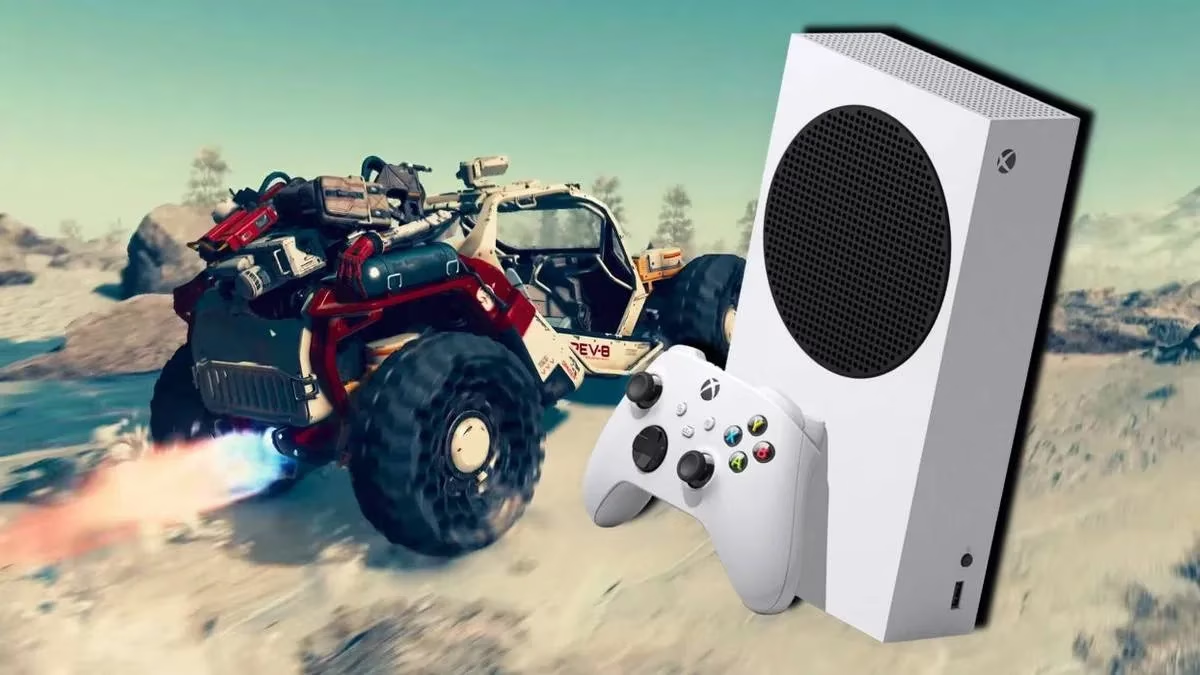
In the sprawling cosmos of Starfield, a lone explorer—let's call her Maya—once stared at her Xbox Series S with a mix of awe and frustration. The planets were breathtaking, the stars infinite, but the experience often felt like wading through molasses. Then came Update 1.13.61. For Maya, and thousands like her, it was the moment the galaxy finally opened up. The update didn't just add a vehicle; it handed Series S players a set of keys to their own destiny. 🚀
Bethesda Game Studios had already made waves at Gamescom's Opening Night Live by revealing the Rev-8, a sleek rover that promised to speed up planetside exploration. For years, critics and fans alike had pointed to traversal as one of the RPG's weakest aspects. Walking across barren moons was tedious; scanning every rock felt like a chore. The Rev-8 changed that, but the full patch notes revealed something even bigger for Xbox Series S owners: a suite of performance options that finally let them choose how their game would run.
According to Bethesda Game Studios on X (formerly Twitter), Update 1.13.61 added a Frame Rate Target, a VSync toggle, and the ability to prioritize either Visuals or Performance. On a console with weaker hardware than its bigger sibling, this was nothing short of revolutionary. Maya remembers the first time she toggled Performance mode. The difference was immediate—a silky 60 frames per second that made combat feel responsive and driving the Rev-8 feel like gliding. But she also noticed the trade-off: lower internal resolution, simplified details, and fewer special effects.
So what matters more to a player? A smooth, stable framerate at the cost of visual fidelity, or a prettier, more expansive game that runs slower? That is the question Update 1.13.61 forces every Series S owner to answer. For some, 60 FPS is non-negotiable. Once they experience the fluidity, going back to 30 frames feels like stepping in quicksand. For others, the allure of higher resolution and richer effects is worth a few stutters—especially when walking across an uninhabited planet where the vistas are breathtaking in their scale.
| Setting | What It Does | Best For |
|---|---|---|
| Performance | Lowers internal resolution and detail to target 60 FPS | Combat, traversal, Rev-8 driving |
| Visuals | Activates more special effects while maintaining highest possible resolution; may cause frame loss | Exploring quiet planets, screenshotting vistas |
| VSync On | Reduces screen tearing by syncing frames to display refresh rate; can drop frames in dense areas | Stable environments, cinematic moments |
| VSync Off | Potentially higher frame rates but may introduce tearing | Players who prioritize responsiveness |
Maya experimented with every combination. She found that in populated areas—cities like New Atlantis or Akila City—the special effects could seriously impact performance. That's where Performance mode shone. But when she landed on a remote moon with no enemies and no NPCs, she switched to Visuals and simply stared. The galaxy had never looked better. 🌌
What about VSync? Activating it tethers Starfield's frames to the refresh rate of the screen, reducing that ugly screen-tearing that can ruin immersion. But in dense areas, it often caused frame drops. Turning it off gave Maya a few extra frames, though at the cost of occasional visual artifacts. It was a classic trade-off, and she appreciated having the choice.
It's worth noting that running Starfield at 60 FPS isn't essential. The game is perfectly playable at 30, and many players happily sacrifice frames for detail. But once you notice the difference—once you feel how much smoother combat and traversal become, especially with the Rev-8—it's difficult to go back. The only time extra detail felt more rewarding to Maya was when she was alone on an uninhabited planet, with nothing but rocks and stars. In populated areas, all those special effects just got in the way.
Whatever a player's preference, the fact that Bethesda provided Xbox Series S owners with this opportunity was a major win. This, coupled with the addition of the Rev-8, made Update 1.13.61 one of the game's most exciting patches yet. At the time, Shattered Space was just a few months away, and the future looked bright. Now, looking back from 2026, it's clear that this update was a turning point. It proved that even weaker hardware could deliver a tailored experience when developers trust players to make their own choices.
Maya still plays Starfield today. She still switches between Performance and Visuals depending on her mood. And she still smiles when she remembers that first patch—the one that turned her Series S from a compromise into a command center. The galaxy has never looked better. ✨