
In the boundless expanse of digital worlds, physics is the silent architect of reality, the unseen hand that guides a player's every step and every leap. Strip it away, and the familiar crumbles into delightful, disorienting chaos. This is the unique magic of zero-gravity mechanics—a design choice that doesn't merely add a feature but inverts an entire paradigm. A straightforward corridor chase transforms into a dizzying ballet up walls and across ceilings; a tactical firefight becomes a three-dimensional puzzle of momentum and trajectory. It is the art of turning a world completely upside down, not as a gimmick, but as a gateway to new forms of challenge, discovery, and profound immersion. The best games understand this, weaving weightlessness not as a momentary spectacle, but as the very fabric of their experience, crafting moments where players don't just observe zero-gravity, but truly feel its exhilarating and terrifying embrace.
🚀 10. Starfield: Unpredictable Cosmic Skirmishes
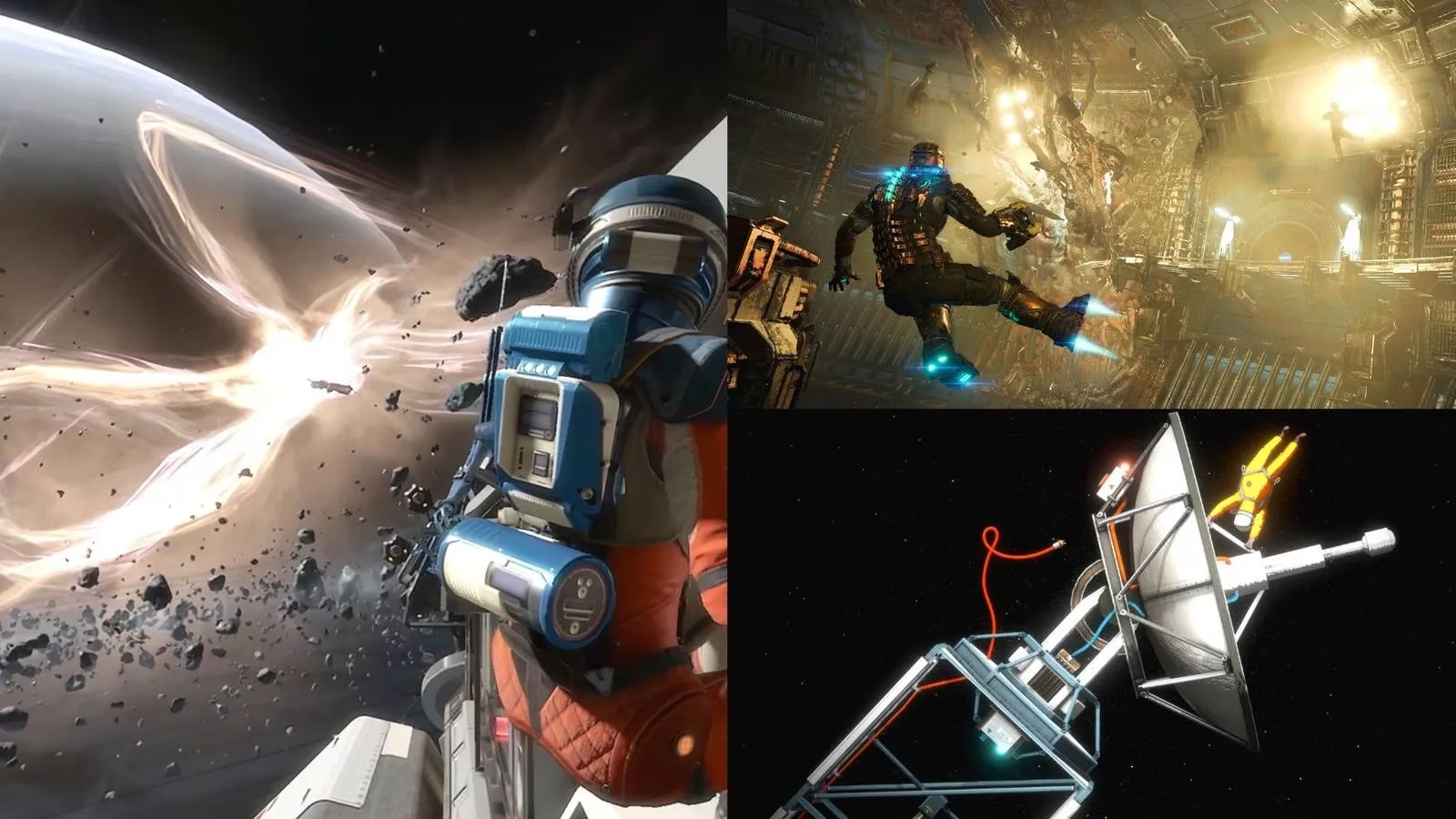
Love it or critique it, Starfield carved its niche with moments of unexpected, weightless warfare. The thrill often lay in the surprise—docking at a seemingly mundane orbital station, only to have the airlock hiss open into a silent, disorienting void where bullets and bodies drift with equal indifference. Combat, already a robust system, gained a new dimension of strangeness. Players could master the push-and-pull of momentum, using a well-timed Grav Dash to become a human projectile, shotgunning a Spacer across the chamber. It was in these chaotic, unscripted zero-G zones that the game's combat shed its straightforward skin, offering pockets of pure, physics-driven fun where the environment itself became both weapon and obstacle.
🤖 9. Observation: The Cold, Observant AI
This narrative thriller masterfully uses zero-gravity to amplify its core themes of helplessness and isolation. Assuming the role of SAM, the station's AI, players witness the remaining human crew not as empowered astronauts, but as fragile, bobbing bodies utterly dependent on your systems. The failing gravity isn't a playground; it's a symptom of the station's mortal decay. Watching these astronauts flail, their duties complicated by simple Newtonian motion, creates a unique and chilling perspective. The zero-G environment becomes a tangible manifestation of their precarious fate, making the player—safe in their digital shell—acutely aware of how easily these fragile lives could be snuffed out, floating silently into the eternal dark.
🌙 8. Deliver Us The Moon: Solitary, Pensive Weightlessness
Stripped of combat, Deliver Us The Moon uses zero-gravity to craft an atmosphere of profound solitude and poignant discovery. As the last hope for Earth, your astronaut navigates derelict lunar facilities where gravity is a memory. Here, puzzles are solved not with quick reflexes, but with careful, considered floating—aligning components, redirecting power flows, all while drifting in a silent tomb. The most rewarding secrets are often tucked away in these weightless sections, requiring a gentle, balletic navigation to reach. Finding a personal log or a faded photograph while suspended in the quiet vastness makes each discovered story fragment feel intensely personal and earned, a whisper from the past heard in the perfect silence of space.
💥 7. Shattered Horizon: The Lost Pioneer of Chaos
Though now a relic, Shattered Horizon was a pioneer, a multiplayer shooter that made zero-gravity its entire battlefield philosophy. This wasn't a limited jetpack boost; this was total, unadulterated Newtonian motion. Skilled players learned to weaponize inertia, clinging to debris, using their thrusters to slingshot around corners, and attacking from literally every conceivable angle. For the uninitiated, it was a frustrating baptism by fire, constantly being ambushed from "above" or "below" in a space that had no such concepts. Its legacy is one of pure, unflinching commitment to its core mechanic, proving that a well-executed zero-G arena could create a uniquely demanding and memorable PvP experience that few games have dared to replicate since.
| Game | Core Zero-G Experience | Key Feeling Evoked |
|---|---|---|
| Starfield | Unpredictable combat arenas | Chaotic fun & surprise |
| Observation | Observing helpless humans | Dread & chilling perspective |
| Deliver Us The Moon | Environmental puzzle-solving | Solitude & poignant discovery |
| Shattered Horizon | Total 3D multiplayer combat | Chaotic mastery & disorientation |
🛸 6. Star Citizen: The Brutal Realism of G-Forces
For players craving simulation-grade realism, Star Citizen's Arena Commander mode delivers a stark, punishing lesson in physics. Its genius lies in extending zero-G logic to the pilot, not just the ship. Execute a high-G turn, and your vision tunnels to black as your character succumbs to G-LOC (G-force induced Loss Of Consciousness). Waking up moments later, adrift and vulnerable as enemy fire streaks past, is a humbling experience. This mechanic transforms dogfights from arcade contests into tense battles of endurance and tactical maneuvering, where managing your own body's limits is as important as managing shields and weapons. It’s a brutal, standout feature that makes the vacuum of space feel authentically hostile.
👨🚀 5. Heavenly Bodies: The Hilarious, Frustrating Truth
Heavenly Bodies is the ultimate test of friendship and coordination, offering a physics simulation so earnest it borders on satire. Controlling an astronaut by manually manipulating each arm and leg with separate controller inputs, the simple task of moving a crate in zero-G becomes an epic, slapstick struggle. Limbs flail independently, sending you spinning into panels as your partner yells conflicting instructions. It is equal parts hilarious and hair-pullingly frustrating—a perfect, silly depiction of how counterintuitive motion without gravity truly is. It doesn't just simulate zero-gravity; it simutes the sheer, comedic human failure to adapt to it, making you profoundly grateful for the solid ground beneath your feet.
🛰️ 4. Adr1ft: Survival in the Silent Void
Blending puzzle-solving with survival tension, Adr1ft places you directly into a nightmare: awake, alone, and floating amid the wreckage of your destroyed station with no memory and a dwindling oxygen supply. Zero-gravity here is not a mechanic but the core state of being, a constant, silent companion to your panic. Navigating the hauntingly beautiful debris field, grabbing onto handholds to pull yourself past twisted metal, is intensely immersive. The ever-present hiss of your air tank, the frantic search for refills amidst the wreckage—all are amplified by the helpless, drifting movement. The terror isn't from monsters, but from the environment itself, making every saved breath a hard-won victory.
🥽 3. Lone Echo: The VR Touch of Weightlessness
Lone Echo achieves what few games can: a near-tactile sense of presence in zero-gravity. As the robot companion to a human astronaut, you navigate a station using your hands—literally. To move, you must reach out, grab a handrail, and push. The world is fully interactive, selling the illusion completely. In VR, this is transformative. Your brain accepts the premise, and the feeling of drifting, of carefully planning your momentum, of watching a tool slowly tumble past you, feels breathtakingly real. It's the closest one can get to a spacewalk without leaving home, a masterclass in using immersive technology to sell a fundamental physical truth.
🪐 2. Prey: The Risky Shortcut Through the Stars
Prey employs zero-gravity not just for set-pieces, but as a brilliant, high-stakes traversal system. The spacewalks outside the Talos I station are a fast-travel method, but one fraught with palpable danger. Exiting the station's artificial gravity leaves you vulnerable, your mobility options stripped away as the alien Typhon lurk among the solar panels and hull plates. Fighting a Technopath while helplessly drifting is a uniquely terrifying challenge that forces improvisation. This marriage of high risk (exposure, vulnerability) with high reward (skipping entire explored sections) makes the choice to step into the void a meaningful, strategic, and always nerve-wracking decision.
😱 1. Dead Space (2023 Remake): The Dread of Rising Feet
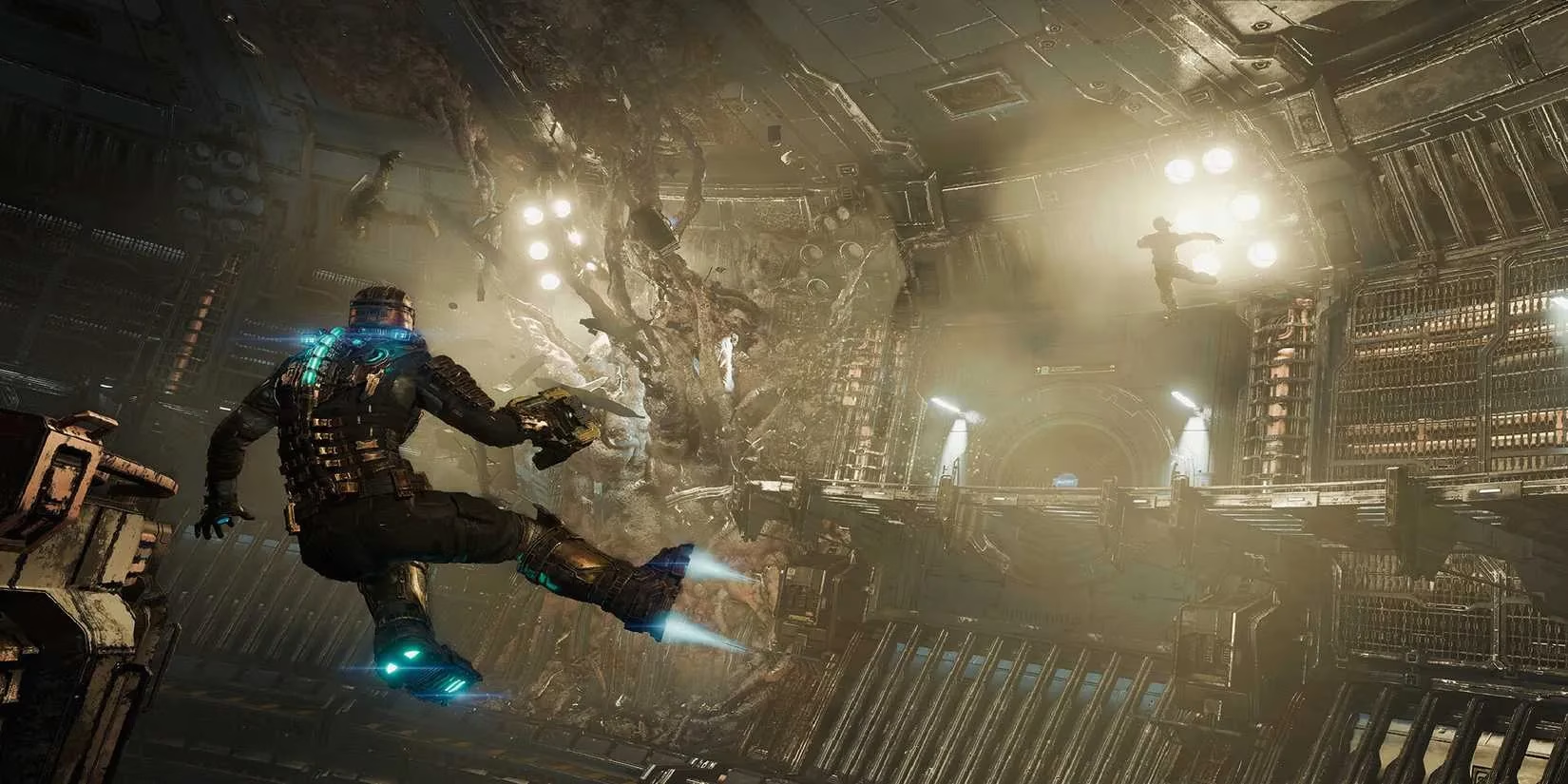
At the pinnacle sits the Dead Space Remake, which took the original's iconic zero-G sections and perfected them into moments of pure, distilled horror. Giving Isaac Clarke intuitive thrusters was a masterstroke—it granted control but never safety. The dread begins the moment your boots lift off the floor, the familiar clunk of footsteps replaced by the ominous silence of drift. The game's already masterful atmosphere of vulnerability is amplified tenfold. Necromorphs don't just walk; they launch themselves from any surface, turning the entire volume of a room into a potential attack vector. The iconic Leaper becomes infinitely more terrifying when it can coil and spring from the ceiling you just floated past. Here, zero-gravity isn't a fun diversion; it's an escalation of the nightmare, a mechanic that makes you dread the very physics it introduces, ensuring that in the cold vacuum of space, only terror has weight.
From the chaotic fun of Starfield to the visceral horror of Dead Space, these games prove that zero-gravity is far more than a visual trick. It is a narrative tool, a puzzle framework, a combat multiplier, and an emotional amplifier. The best implementations make players feel the absence of gravity—the disorientation, the freedom, the vulnerability, the silent, profound loneliness. They remind us that in the vast, uncaring theatre of the cosmos, the rules are different, and the greatest adventures—and terrors—begin when we dare to let go.